Every holiday season, the retail headlines are about sales. Black Friday, Cyber Monday and Christmas bring more shoppers, more orders and more card payments than any other time of the year.
But the story does not end at checkout. A share of those purchases comes back as payment disputes and chargebacks. They arrive weeks later, through January and February, when a parcel has not shown up, a refund is still pending or a cardholder does not recognise a charge on their statement.
Sound familiar? If you handle disputes at a bank, a fintech or a card issuer, every one of those cases ends up with your team. Here is what to expect, and how to get ahead of it.

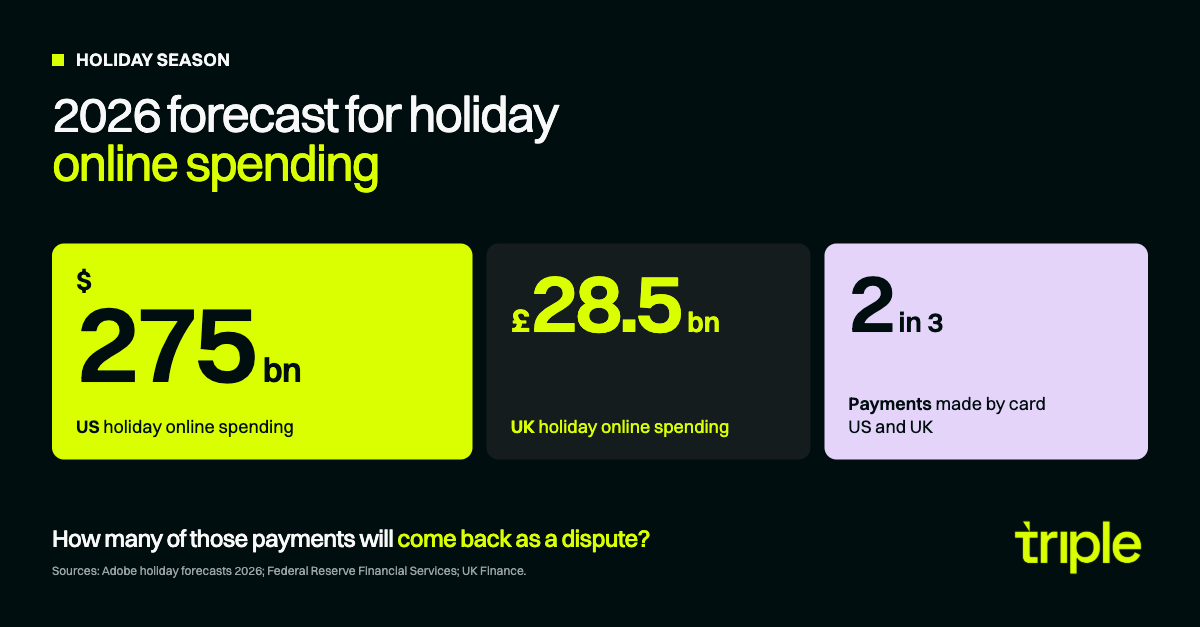
The holiday season is the busiest time of the year for retail, in store and online. Forecasts for 2026 point to another record in online spending: $275 billion in the US and £28.5 billion in the UK.
But spending is only half the picture. The other half is how people pay: In both the US and the UK, roughly two out of every three payments are made by card. In Mexico, 77% of purchases during the 2025 edition of Buen Fin, a nationwide sales event held every November and similar to Black Friday, were paid by card, according to its Ministry of Economy.
Which leaves a question: how many of those payments will come back as a dispute?
Payment disputes rise after the holidays because more can go wrong with a purchase after it is paid for, and the holiday season brings far more purchases.
These are not the only reasons. Fraud, cancelled subscriptions and charges a cardholder does not recognise lead to disputes too. Any of these problems can end with a cardholder disputing the payment with their bank.
The pressure is growing. 80% of financial institutions report that their dispute volumes are rising.
How a dispute ends also affects card use. In a 2026 survey of issuers, 76% saw card use increase after a non-fraud dispute was resolved in the cardholder's favour. When the outcome went against the cardholder, 27% saw it fall.
Three things are key for a dispute team getting ready for the holiday season.

Every market has its own end date for the season. In some it is Christmas. In others, like Spain, it runs to Three Kings' Day on 6 January. The disputes that follow do not stop there.
Preparing before the season gives issuers time to work on both fronts: preventing the disputes that come from confusion, and resolving the rest faster.
At Triple, we help banks, fintechs and card issuers prevent and resolve payment disputes with transaction data and AI. If you want to see how it works, get in touch with our team.